
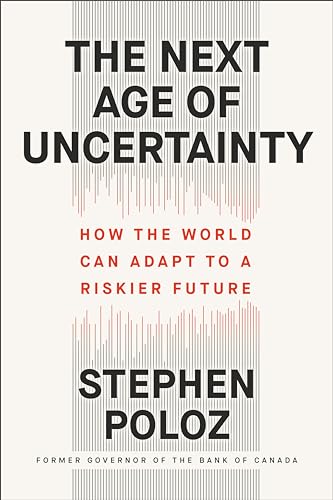
The next age of uncertainty : how the world can adapt to a riskier future / Stephen Poloz.
Material type: TextPublisher: [Toronto, Ontario] : Allen Lane, 2022Copyright date: ©2022Description: 253 pages ; 24 cmContent type:
 - text
- unmediated
- volume
- 0735243905
- 9780735243903
- 338.5/42 23
- HB3711 .P7445 2022
- cci1icc
| Item type | Current library | Call number | Status | Date due | Barcode |
|---|---|---|---|---|---|
| Normal Collection | National Defence College (NDC) Library | HB3711 .P7445 2022 (Browse shelf(Opens below)) | Available | 10144/26 | |
| Normal Collection | National Defence College (NDC) Library | HB3711 .P7445 2022 (Browse shelf(Opens below)) | Available | 10146/26 | |
| Normal Collection | National Defence College (NDC) Library | HB3711 .P7445 2022 (Browse shelf(Opens below)) | Available | 10142/26 | |
| Normal Collection | National Defence College (NDC) Library | HB3711 .P7445 2022 (Browse shelf(Opens below)) | Available | 10143/26 | |
| Normal Collection | National Defence College (NDC) Library | HB3711 .P7445 2022 (Browse shelf(Opens below)) | Available | 10145/26 |
Browsing National Defence College (NDC) Library shelves Close shelf browser (Hides shelf browser)

|
|
|
|
No cover image available | No cover image available |

|
||
| HB3711 .P7445 2022 The next age of uncertainty : how the world can adapt to a riskier future / | HB3711 .P7445 2022 The next age of uncertainty : how the world can adapt to a riskier future / | HB3711 .P7445 2022 The next age of uncertainty : how the world can adapt to a riskier future / | HB3711 .P7445 2022 The next age of uncertainty : how the world can adapt to a riskier future / | HC103 .F3 1960 American economic history. | HC103 .H4 1966 The limits of American capitalism | HC103 .H75 1994 American economic history / |
Includes bibliographical references (pages 252-253)
"The accessible roadmap to navigating an unpredictable economic earthquake. People are worried about their financial future. The workforce is aging, meaning slower economic growth. Debt is going through the roof, both public and private. Automation and technological revolution are putting people out of work, leading to ever-growing inequality and social breakdown. Add the existential threat of climate change to the list of economic stresses. Then pile on a global pandemic that has cost the global economy trillions. It's not surprising that people are worried. Crises don't unfold because of just one of these factors happening in isolation. Former Governor of the Bank of Canada, Stephen Poloz, calls these factors "tectonic" stresses. As he demonstrates, using examples from previous cycles of boom and bust, major crises occur when several forces converge, like tectonic plates. When the built-up energy is released, the result is an economic crisis. Whether we are barreling towards another financial crisis depends on how the current stresses are handled. Slow growth can be a good thing, as it means low interest rates, and could lead to more home ownership. Our panic about debt, Poloz argues, is a holdover from the financial conditions of the 1930s. Technological change can mean disruption and inequality--but can also lead to greater prosperity for all in the long term, something we can accelerate with good policy. And while responding to climate change will be expensive and difficult, it can also lead to better policies around investment and employment, to say nothing of technological advance. Using examples from the last 150 years of economic history, Stephen Poloz explains ideas sophisticated enough for institutional investors and policymakers in language accessible enough for general readers who are just worried about renewing their mortgages in a climate of fluctuating interest rates. Highly readable and from an acclaimed economist, The Next Age of Uncertainty will be an indispensable guide to the turbulent decades ahead."-- Provided by publisher.
Issued also in electronic format.
There are no comments on this title.