
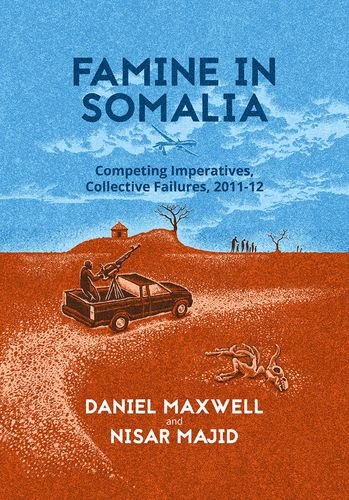
Famine in Somalia : competing imperatives, collective failures, 2011-12 / Daniel Maxwell, Nisar Majid.
Material type: TextPublisher: New York : Oxford University Press, [2016]Description: xvii, 269 pages : maps, charts ; 22 cmContent type:
 - text
- unmediated
- volume
- 0190499389
- 9780190499389
- Competing imperatives, collective failures, 2011-12
- 363.8 23
- HC79.F3 M39 2016
| Item type | Current library | Call number | Status | Date due | Barcode |
|---|---|---|---|---|---|
| Normal Collection | International Peace Support Training Centre (IPSTC) | HC79.F3 M39 2016 (Browse shelf(Opens below)) | Available | 200128842020 |
Includes bibliographical references (pages 207-260) and index.
Introduction -- The problem of famines -- Somalia and external intervention in the Greater Horn of Africa: 1970-2010 -- The worsening crisis, the delay, and the impact of the famine -- "No one to cry to" : a Somali narrative of the famine -- Diversification, flexibility, and social connectedness: understanding the narratives -- The response of the (Western) international "humanitarian community" -- The shifting international dynamics of the humanitarian response -- 2012-14 and the aftermath of famine -- Preventing famine: an unfinished agenda?
"Some 250,000 people died in the southern Somalia famine of 2011-12, which also displaced and destroyed the livelihoods of hundreds of thousands more. Yet this crisis had been predicted nearly a year earlier. The harshest drought in Somalia's recent history coincided with a global spike in food prices, hitting this arid, import-dependent country hard. The policies of Al-Shabaab, a militant Islamist group that controlled southern Somalia, exacerbated an already difficult situation, barring most humanitarian assistance, while the government's counter-terrorism policies criminalized any aid falling into their hands. A major disaster resulted from the production and market failures precipitated by the drought and food price crisis, while the famine itself was the result of the failure to quickly respond to these events - and was thus largely human-made. This book analyses the famine: the trade-offs between competing policy priorities that led to it, the collective failure in response, and how those affected by it attempted to protect themselves and their livelihoods. It also examines the humanitarian response, including actors that had not previously been particularly visible in Somalia - from Turkey, the Middle East, and Islamic charities worldwide." --Cover.
There are no comments on this title.